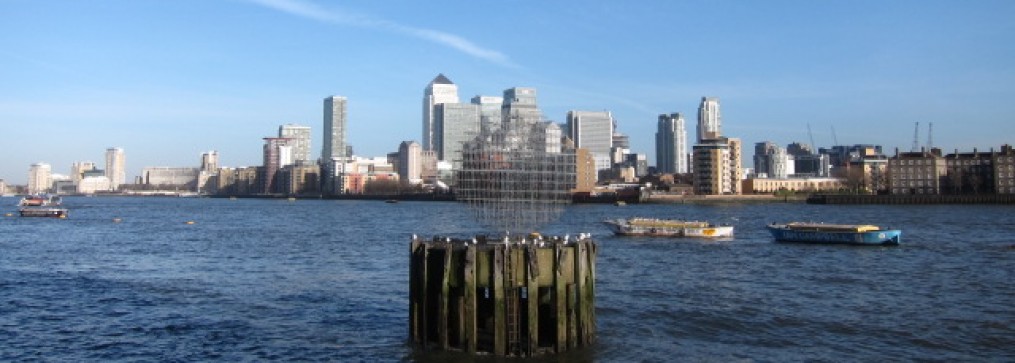

I haven’t worked out the overall score for today, but although it feels in general like a bronze day, or perhaps a silver one, it is going to be recorded forever more as a diamond day, because of the sense of achievement, and the particularly special part I completed.
Today, I crossed the Severn Bridge. I have now completed all the way from the Humber Estuary to the Severn Estuary (except the last element along the Thames that will be the final weekend, and the 4 miles at Bigbury that are still haunting me). I think I can say, however, that I have completed the south of England and am now in beautiful Wales.
It was generally an easy day. I left at the crack of dawn from Clifton Down station and reached Avonmouth just as it was getting light – around 7.30am. The road through the docks was incredibly busy and smelly (there was definitely something very dead somewhere) and I could almost feel my lungs being coated with black slime as the lorries thundered past.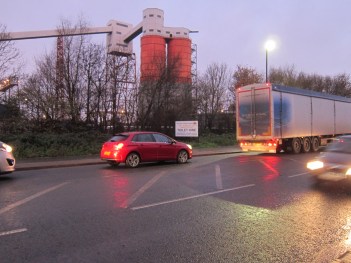
Eventually the path (part of the Severn Way) leaves the road and runs beside the railway track, between hedges of brambles. At Severn Beach, the path becomes a promenade, where the early fishermen were out in force.
The fog that had been expected yesterday, turned up today, so although it was not cold, I could see very little of the view. There was no sign of the lower Severn Bridge, although I could hear traffic and the beeping of horns. It was quite strange, as the bridge is so enormous, to know it was there, but invisible. It did not emerge from the mist until I was no more than 30 yards away – and even then, I could only see the couple of pillars nearest me. The sun was struggling to come through, and I hoped that it would come out to allow me to see the upper bridge, which was my crossing point.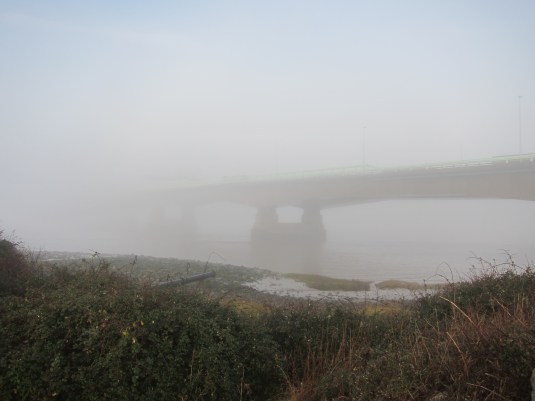
I passed under the bridge, the trucks on the M4 roaring over my head, and continued along the promenade, which meandered for about half a mile, before turning inland and becoming a very easy track along dykes built to manage the salt marsh. Looking back, I could see the mist clearing and part of the bridge now visible. Ahead, there was still no sign of the second bridge. The sun was trying harder, and the grass was glossy green.
The path led onto a lane, and I rejoiced to see the tip of what I thought was part of the bridge, only to realise it was a metal pylon from previous engineering works, but after another ten minutes, bits of bridge became fleetingly visible as the mist rolled back and partially broke up.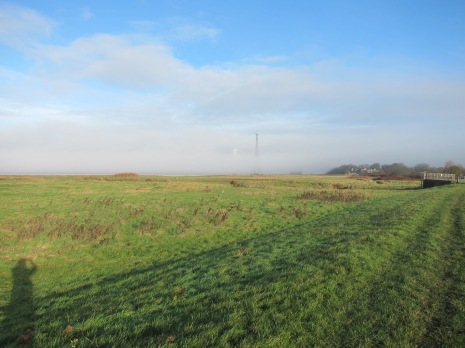
I reached Aust around eleven. I was so hungry I could have eaten my own arm. Normally, I don’t worry too much about food when walking, but obviously, I had not had enough breakfast. I debated walking into Aust to see if there were a shop, although it did not look hopeful, and I was reluctant to add a half mile each way. I whipped out the phone (normally well hidden and turned off when walking) and saw that the motorway services were not far. So I elected to cross the motorway, on a walkway across the toll-booths of the M48 and grab an early lunch.
Fortified, I returned to the south side and began the big adventure. The upside of it being misty was that there was little wind. I muffled up and pulled on my hood, but was not particularly cold. There is a walkway on either side, but I had decided on the south side, as my original idea of going to Chepstow was superseded by the decision to carry on as far as Severn Tunnel Junction.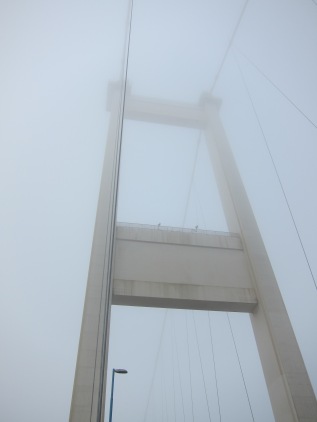
As I walked over, stopping for frequent pictures, I was amazed at the number of motorway maintenance vans that tootled up and down the walkway. Not sure where they were all going as they trundled along at 10 miles per hour, stopping for a chat as they passed each other.
Crossing the bridge took about twenty minutes. I then joined the Wales Coast Path. I must say I am hugely impressed with the signage. At every point where there might be confusion, there is a marker, and the ones at the stiles are tall, with yellow tips, so you can see them as you scan the far side of a field, looking for the exit.
The path was easy, behind various factories, then down along the estuary shore. There was so much mud in parts, it nearly sucked my boots off, but the trip was uneventful. The only bovines were docile Welsh Blacks, not feisty Friesians, and so they paid no attention to me. I passed an ancient holy well site, dedicated to the Celtic king, Tewrig, who scored a nifty victory over the Saxons not far away. The statue of 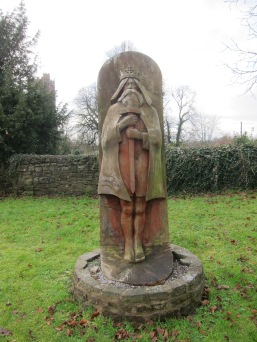 him showed him crowned, but unshod. An early example of ‘all fur coat and no knickers’, I suppose.
I won’t bore you all with the appalling Great Western Rail service back to Clifton Down: suffice to say, it was not the highlight of the day. 17.5 miles
 disappeared some 150 years ago, there is a track through a rather pleasant stand of trees. After a mile or so, it drops down onto the beach at Sandy Bay. Another walk along the sands for a good couple of miles and I was eating up the planned 18 miles.
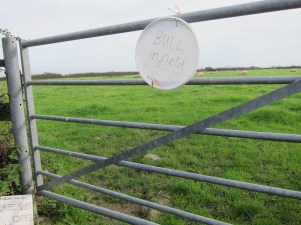 This was hard to believe. Even the most cantankerous farmer wouldn’t keep a bull on a bridleway. I looked around and the field appeared to contain only sheep. Some very poor signposting later, I emerged onto a track. This decanted directly into a farm yard, with a padlocked gate at one end and more scrap than Steptoe and Son’s yard. I could see another track, so, thinking that must be the exit I followed it through piles of rusting junk. Another locked gate. Up and over.
 glad I had not given up. The walk was pleasant and easy, with the sound of the sea in my ears. I made excellent time, and was quite surprised when I came to the end of the path considerably earlier than expected. As usual, there were no way markers. I walked up the road, and found myself in one of those housing estates that are like a maze. I asked the way to the main road. The man looked surprised when I mentioned my destination, but directed me. When I got to the junction, it looked nothing like the map – no wonder I was surprised at my speed. I had not come nearly as far as I thought. I had at least 2 miles to do on the road. Thoroughly annoyed by now, I snagged another bus, and got to the meeting point with just enough time to buy food for the train.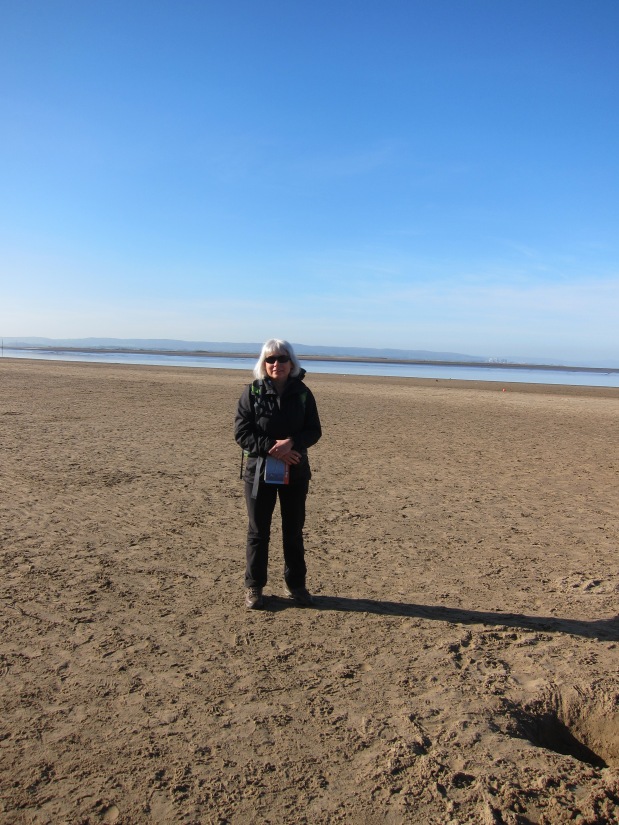
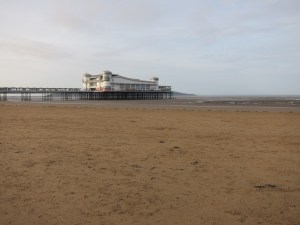
 adful service) to meet Jane at the Pavilion on the waterfront at 9.30. We had a dismal breakfast there – grease on toast – but that was the lowest point of the day.
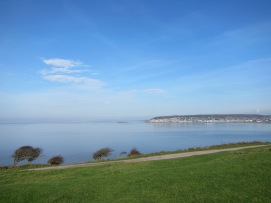 All the way back to West Quantoxhead, hazy in the distance, and the long flat expanse of Brean sands to the south, then the delightful villas of Weston to the north. The Down is the last outcrop of the Mendip Hills which we could see rolling away east. We descended and had a quick cream tea in the NT café at the bottom.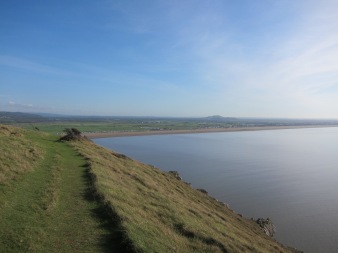
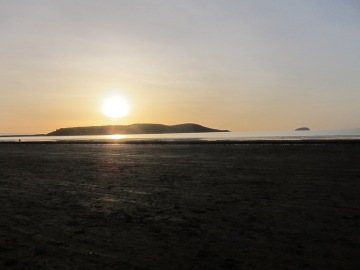 each and a long walk up to the middle of Weston-super-Mare, admiring the Holm islands (Steep and Flat) and Brean Down behind us.
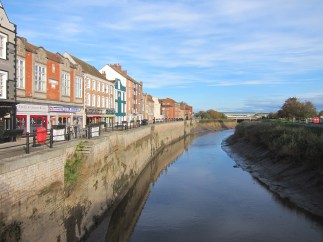
 It then winds backwards and forwards along the riverbank. Some interesting information about Bridgwater was on the various interpretation boards. Most of the towns in the area were once navigable by river to trading craft, and Bridgwater itself had a big export market for its bricks and tiles. There was once a castle here and there are some handsome early eighteenth century houses.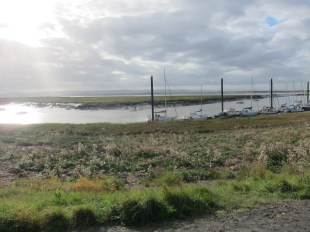
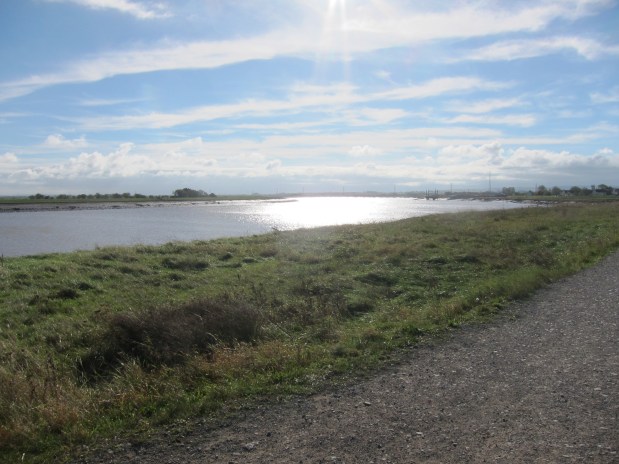
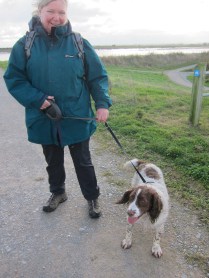
 meeting with my friend Vicki and her dog, Bracken, at Combwich, to make up for it at lunch. To get back onto the coast, I had to go cross country. It was deeply uninspiring. Quite a long stretch was thought the fields of one of those farmers who clearly don’t want walkers on their land, but won’t actually break the law by closing paths: signs obscured with carefully untrimmed brambles; broken stiles and gates are tied shut with binder twine with tight knots. This resulted in a few tedious backtracks as I got stranded on the wrong side of the dykes that separate the fields.
 The weather was very different from yesterday. A cold wind, and overcast. I reached the path around 8.45 and followed it along tracks and ridges to Steart point. The last 1.5 miles out to the point is very dull indeed. The high rushes on both sides made it impossible to sea the sea, and the path was made of large shingle – clearly not designed by any one who actually does long distance walking. 5 minutes in shingle n the beach is ok, but over a longer stretch it is painful and slow.


 . Although there are signs pointing down to the beaches, it is not easy to know when to leave them. I saw one slip coming down and a lady walking a dog told me take it, and walk through the little hamlet behind the caravan park. With no other clues, I took her word for it. The path climbed a cliff then dropped down onto another beach with even more fascinating rock formations than the first.
 However, the path was closed and brought me the west side of the power station, down a track into Shurton. I arrived at 1.30, having done an easy 10 miles, rather than the 12 I planned, but there is no point doing more this afternoon, as I’d have to backtrack and then repeat it tomorrow. I am planning to meet Vicki and her spaniel tomorrow for a walk down the Parrett river.
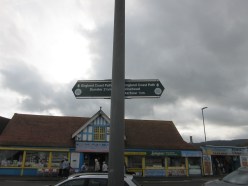 Somerset has now completed its stretch of the England Coast Path. The route runs along the prom, then around the edge of the West Somerset golf links, before dropping down onto the beach at Dunster. Inland, the enormous mediaeval pile of Dunster caste dominates the countryside, while to the seaward side, the coast of Wales was visible. It was a dull and cloudy day, so the opposite shore was not very clear, although the Porth Talbot steelworks are easily identified.

 Melita's Coast of Britain Walk